Hearing Testing in Bay Ridge, Midtown South, Middle Village, and Williamsburg Brooklyn
Do you know what you are missing?
The truth is with hearing loss you don’t know. Once your brain stops registering specific sounds, you don’t even know they are there.
If it’s spring, ever wonder why you don’t hear the robin outside your window? They haven’t gone away. It’s just you can’t hear them anymore, along with a host of other sounds. It’s worth getting your hearing checked to find out what you are missing. Then you can decide if you really want to be tuned in or tuned out.

Why get a hearing test?
The World Health Organization projects that by the year 2050, one in every ten people will have debilitating hearing loss that requires intervention. This is even worse as you get older: One in every 3 people over the age of 65 have hearing loss.
Yet many people are unaware that they have hearing loss. That’s because hearing loss often progresses quite slowly, making any deterioration easy to miss until the damage is irreversible. Hearing tests help track your hearing over time and catch hearing loss early.
After all, hearing loss is a serious issue. If left untreated, it can lead to serious health issues, including cognitive decline. Why risk that when hearing tests are simple and painless?
Hearing tests:
- Catch hearing loss early
- Determine which hearing loss solutions are best for you
- Help you customize and program your hearing aids
How do I know if my hearing is bad, and when should I get tested?
Have you tried this super simple hearing test?
Ask your spouse, your kids, and your friends if they think you should get your hearing tested. Chances are, you don’t even need to ask. They’ve probably been telling you for years to see a specialist and get your hearing tested.
Yes, most of us are more stubborn than a mule and have put off acknowledging our hearing loss for years and years. But, whether you’re experiencing symptoms or not, hearing tests are proactive steps you can take to protect your hearing and detect problems early.
The general guidelines for such hearing tests are:
- If you are under 50 and have no signs of hearing loss: You should generally have your hearing tested every 3 years.
- 50 – 65: You should have your hearing tests at least once every two years. One in every four adults who report excellent hearing actually has some hearing loss, so it’s a good idea to get tested even if you aren’t noticing symptoms.
- 65 or older: At this age, more than 30 percent of people have hearing loss. You should get your hearing checked annually.
Experts also recommend that you undergo at least one hearing test after reaching the age of 20 in order to establish a hearing baseline.
The frequency of these hearing tests can and should change if you begin noticing that you’re having hearing problems.
7 telltale signs you need a hearing test
Consider getting a hearing test if you:
- Begin to withdraw from social settings. For example, if you avoid going out with friends or co-workers.
- Have significant fatigue or memory problems, even if you’re getting enough sleep.
- Notice that voices sound muffled or distant when talking to other people.
- Have trouble understanding conversations because it feels as though letters or sounds keep dropping out–especially consonants.
- Need to consistently turn up the volume on your radio, mobile phone, or television.
- Ask others to speak up or repeat themselves frequently.
- Can’t understand speech in a crowd or in noisy situations.
If you suspect you are experiencing the symptoms of tinnitus, hearing loss, it’s important to undergo a hearing test as quickly as possible. The sooner you undergo your hearing test, the faster you will be able to hear better.
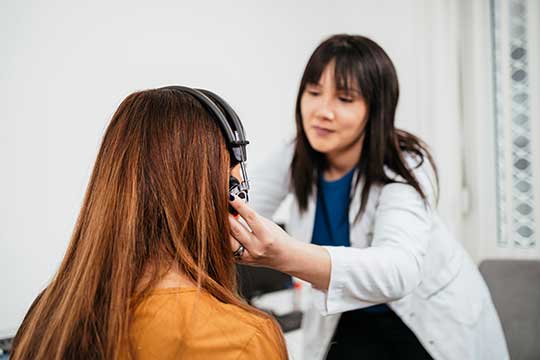
How can I test my hearing?
Every day you wake up is a test, and every day your family or friends talk to you is a test too. And it’d be easy to think everything is fine or almost perfect based on what you are hearing. Of course, the big problem is that there is a good chance you’ve already forgotten what you are missing. That happens to the best of us.
Which is why a professional hearing test is so important. You’ll discover what frequencies and types of sounds have gone missing and options for making them part of your life again, including hearing when your spouse or friend asks you to help with the dishes.
It’s easy to get started. Schedule a hearing test with us in Brooklyn & Greater New York City to see if hearing aids will improve your ability to hear.
Our hearing test will check your ability to hear different frequencies. Most people will lose the ability to hear very low or high frequency sounds before there is any noticeable deterioration of the ability to detect mid-frequency noises.
All of this information is then displayed on an easy-to-read graph, called an audiogram. Effectively addressing your hearing loss depends on the ability to amplify the wavelengths you have difficulty hearing, making an audiogram an indispensable first step.
Types of hearing tests in Brooklyn & Greater New York City, NY
There are many ways to test your hearing, including:
Pure-tone audiometry
During this test, your hearing specialist will instruct you to listen to tones at different frequencies and volumes.
Speech and noise-in-words tests
These tests eschew the quiet room approach in order to determine how well your hearing functions in noisy situations. The idea behind this approach is to mimic how your hearing behaves in life, especially in noisy situations.
Tympanometry
By gently pushing air into your ear, this test measures how well your eardrum moves and is an important hearing test for your middle ear. The results will show us if your eardrum is too stiff, has fluid behind it, or has a hole in it.
What Happens at Your Hearing Test in Brooklyn, Middle Village,
NY — and What Comes Next
We know that for many people, making the first appointment is the hardest part. Here’s exactly what to expect when you come in so there are no surprises.
When you arrive: You’ll be greeted by our front office team and asked to complete a few intake forms covering your personal information, medical history, and current hearing concerns. This information helps us tailor the evaluation to your specific situation before the test even begins.
Your evaluation: One of our hearing specialists will review your history with you and ask follow-up questions — where you’re having trouble, what situations feel hardest, any relevant noise exposure or family history. We’ll then conduct a physical exam of your ear canals followed by the appropriate diagnostic tests for your situation, which may include pure-tone audiometry, speech-in-noise testing, and tympanometry.
Your results: We review your audiogram with you in plain language immediately after testing. We’ll walk you through which frequencies you’re hearing well and where gaps have developed — and what those gaps mean in real-world listening situations, like following a conversation at a family dinner or hearing clearly on the phone.
What comes next depends entirely on what we find:
- No hearing loss detected — We establish a baseline audiogram to track your hearing health over time and recommend a follow-up schedule based on your age and risk factors
- Mild to moderate hearing loss — We discuss hearing aid options, lifestyle adjustments, and, if appropriate, treatment for any related tinnitus
- Moderate to severe hearing loss — We’ll review the full range of options including advanced hearing aid technology and, when indicated, referral to an ENT physician or cochlear implant program
- Other findings — If we identify signs of a medical condition (fluid, perforation, abnormal middle ear function), we’ll let you know and guide you to appropriate follow-up care
There is no obligation and no pressure at your appointment. Our goal is to give you a complete, accurate picture of your hearing health and the information you need to make the right decision for your life.
Insurance: Many insurance plans cover diagnostic hearing evaluations. We recommend calling our office ahead of your visit to verify your benefits — our team will help you understand your coverage before you arrive.
Schedule Your Hearing Test in New York 718-841-0717
Why Your Hearing Test Is Also a Brain Health Check
Most people think of a hearing test as something you do when you can’t hear well anymore. But at Audiological Diagnostics, PC, we see a comprehensive hearing evaluation as an important part of your overall health — not just your ear health.
Here’s why: hearing loss and brain function are deeply connected. When the auditory system stops delivering clear signals, the brain has to work harder to fill in the gaps. Over time, that cognitive overload — combined with the social withdrawal that often follows hearing loss — takes a measurable toll.
What the research shows:
- Adults with untreated hearing loss experience cognitive decline up to 40% faster than those with normal hearing or those who address hearing loss with hearing aids
- Untreated hearing loss is now recognized as one of the most significant modifiable risk factors for dementia — meaning it’s something you can actually act on
- Social isolation driven by hearing difficulty is independently associated with depression, anxiety, and accelerated cognitive aging
- Treating hearing loss has been shown in multiple studies to slow cognitive decline and improve quality of life outcomes
What this means for a hearing test in Brooklyn:
When you come in for your evaluation at any of our four New York locations, we aren’t just measuring which tones you can hear. We’re establishing a complete picture of your auditory health that informs your broader wellbeing — and gives you an early warning system if things are changing.
Hearing loss often progresses slowly, making any deterioration easy to miss until the damage is irreversible. kirschaudiology A hearing test doesn’t just tell you where your hearing stands today. It gives us a baseline against which future changes can be tracked — so that if your hearing does decline, we catch it early, when your options are widest.
Whether you’re 35 or 75, proactive or symptomatic, your hearing is worth checking — and protecting.
Learn More About Hearing Loss and Brain Health