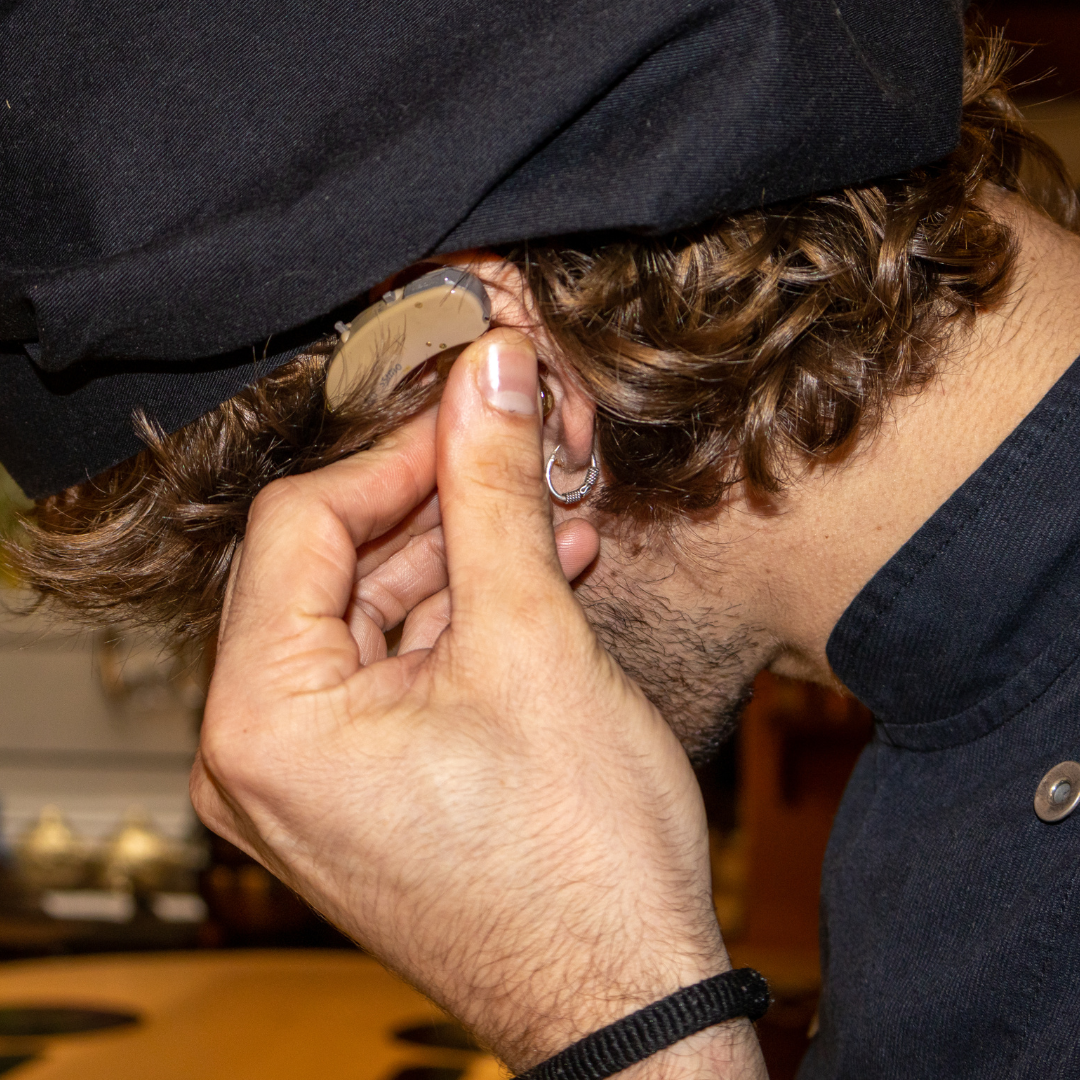
Maintaining dinner dialogue proves demanding when chaotic ambient noise strains your concentration and hearing. We perform comprehensive diagnostic assessments to evaluate hearing in quiet rooms and challenging acoustic spaces to identify functional deficits. After diagnosing the source of your difficult hearing, we design targeted interventions tailored to your listening needs.
Why Everyday Hearing Fails in Busy, Noisy Restaurants
Quiet rooms provide a favorable signal-to-noise ratio, meaning a speaker’s voice is much clearer than the sounds around it. Restaurants create the opposite situation. Overlapping chatter, piped music, kitchen clatter, and hard-surface reverberation mask speech, forcing the brain to expend immense cognitive effort to track conversation.
These communication barriers frequently indicate high-frequency hearing loss, central auditory-processing disorders, or age-related sensorineural changes. Attention, fatigue, dim lighting, and distance from the speaker may make it worse. Certain patients demonstrate normal sensitivity on routine audiograms while struggling significantly during advanced speech-in-noise testing. Inability to track speech in crowded restaurants merits audiological evaluation even when standard daily hearing sounds completely normal.
Diagnostic Protocols for High-Frequency Hearing Loss
We begin with a history of the situations that cause trouble, along with questions about noise exposure, tinnitus, medications, family history, and changes in either ear.
Through pure-tone audiometry, we determine your faintest auditory perception across low to high pitches utilizing both air and bone conduction testing. High-frequency hearing loss commonly presents on the audiogram as a characteristic precipitous drop in the higher frequency ranges. Extended test batteries incorporate acoustic tympanometry to rule out middle-ear pathology along with suprathreshold word-recognition testing.
Since sound-treated booths cannot replicate the chaos of a crowded dining room, speech-in-noise testing provides critical real-world insight. It calculates your ability to identify verbal phrases as competing background noise levels rise. Together, these results show whether the problem involves audibility, speech clarity, background-noise processing, or a combination of factors.
Understanding Auditory Processing Disorders in Noisy Environments
An auditory processing disorder affects how the central auditory nervous system interprets sound. Even when the ears detect individual frequencies accurately, the central auditory system may falter at sorting overlapping voices, distinguishing close speech sounds, or processing fast-paced dialogue. Our clinical team starts by examining peripheral auditory thresholds, subsequently deciding if an auditory-processing test battery or multidisciplinary consultation is necessary.
How to Improve Speech Clarity in Challenging Acoustic Environments
Minor environmental adjustments can boost speech acoustic signals and supply critical visual lip-reading cues. Before heading out to eat, select dining spots with quieter acoustic profiles or dine during low-volume hours. Dining locations utilizing sound-absorbing elements like booths, felt panels, window curtains, and carpet offer better acoustics than high-ceilinged rooms with hard surfaces.
Upon entering the restaurant:
- Request table placement positioned away from dishwashing stations, bustling bars, sound speakers, and celebratory gatherings.
- Position your chair against a perimeter wall to diminish competing auditory chatter behind your head.
- Position yourself to directly face companions under bright lighting to enhance facial comprehension.
- Reduce physical spacing between yourself and companions to maximize direct speech perception.
- Position your better-hearing ear directly toward your main conversational partner.
- Request that companions rephrase misunderstandings using different words rather than repeating the same sentence.
- Verifiably confirm essential conversational facts instead of bluffing comprehension.
- Step away for a brief auditory rest when cognitive listening fatigue begins to set in.
- Ask dinner guests to speak with clear enunciation at a steady, natural conversational rate.
- Speaking with excessive volume creates acoustic distortion that fails to make words clearer.
The Best Hearing Devices for Overcoming Restaurant Noise
The best technology depends on the cause of the difficulty, the listening environment, and whether hearing loss is present. Modern clinical hearing aids integrate directional microphone polar patterns, automated digital noise suppression, and personalized restaurant memory settings to highlight frontal speech and reduce background competition. Users should establish realistic expectations because no hearing device can fully eradicate all unwanted ambient speech.
Incorporating a dedicated remote microphone provides an even more pronounced improvement in signal-to-noise ratio. Positioned near or clipped to the speaker, the device transmits raw speech audio directly to paired hearing aids or external listening receivers. Direct audio routing minimizes the acoustic penalty of conversational distance and surrounding environmental din.
Further practical hearing technology options include:
- Wireless conference table microphones that capture multi-speaker discussions
- Built-in telecoils linking directly with induction hearing-loop systems in public venues
- Mobile speech-to-text applications delivering instant visual captions during dinner
- Consumer wireless earbuds or hearables featuring customizable assistive listening modes
- Sound-meter apps and acoustic dining directories for locating quiet venues
We evaluate these technological options, ensure full hardware compatibility, and instruct you on maximizing your selected system.
How an Audiologist or Physician Can Improve Hearing in Noise
Undergoing a formal hearing evaluation takes your care beyond the limited baseline of hearing adequately in quiet spaces. Our audiology team assesses the unique environments, speaking partners, and ambient noise profiles that challenge you to choose targeted diagnostic tools. The assessment may include pure-tone thresholds, middle-ear testing, word recognition, and speech-in-noise measures. Specialized auditory-processing testing can be ordered when patient history and preliminary audiometric findings warrant deeper neural investigation.
Sudden unilateral hearing drops, acute asymmetric changes, or rapid auditory decline mandate evaluation by an ear, nose, and throat physician. Personalized care identifies the source of the difficulty rather than assuming restaurant noise is the only problem.
Schedule a Diagnostic Hearing Evaluation Right Away
If crowded restaurant settings cause you to feel disconnected, tired, or forced to guess at conversations, arrange a diagnostic hearing evaluation today. We provide proven treatments to enhance your hearing in noisy environments, offering hearing aid fine-tuning, specialized assistive accessories, and individualized auditory therapy.
Contact our practice today to book your consultation and take a decisive step toward reconnecting in social settings.